.png)
The Operational Risks of Scaling Without Financial Structure
Introduction: Growth Without Structure Creates Hidden Risk
Growth is exciting because it feels like validation. Revenue increases, client rosters expand, and the business feels more established. But growth also has a relentless way of exposing every structural weakness hidden beneath the surface.
The bookkeeping system that worked for a $500K business breaks at $3M. Financial reports take weeks to close, cash flow becomes unpredictable, payroll grows complex, and leadership starts making high-stakes decisions using outdated or un-reconciled data.
Scaling without financial structure rarely triggers an immediate collapse overnight. Instead, it creates gradual compression: blind spots, margin erosion, and small process failures that become remarkably expensive as the enterprise expands. At Olga Kvach CPA, we view financial structure as the foundation of sustainable scaling. Without it, growth isn't building value—it is multiplying risk.

Scaling Paradigms: Unstructured Growth vs. Engineered Architecture
Operational Dimension | Scaling Without Structure (High Risk) | Scaling With Financial Architecture |
Top-Line Focus | "Revenue Illusion" (High sales, shrinking cash). | Unit Economics (Tracking margin by service line/tier). |
Cash Management | Bank balance observation; reactive transfers. | 13-Week Rolling Cash Forecast; isolated tax reserves. |
Reporting Cadence | Historical reporting delayed by 30–60 days. | Real-time monthly closes and quarterly strategic syncs. |
Internal Controls | Informal owner sign-offs; unmonitored cards. | Multi-factor dual-authorization; segregation of duties. |
Tax Planning | Seasonal filing-time reaction; cash surprises. | Year-round OBBBA-aligned tax modeling and PTET strategy. |
The Core Operational Risks of Unstructured Growth
1. The Revenue Illusion and Margin Compression
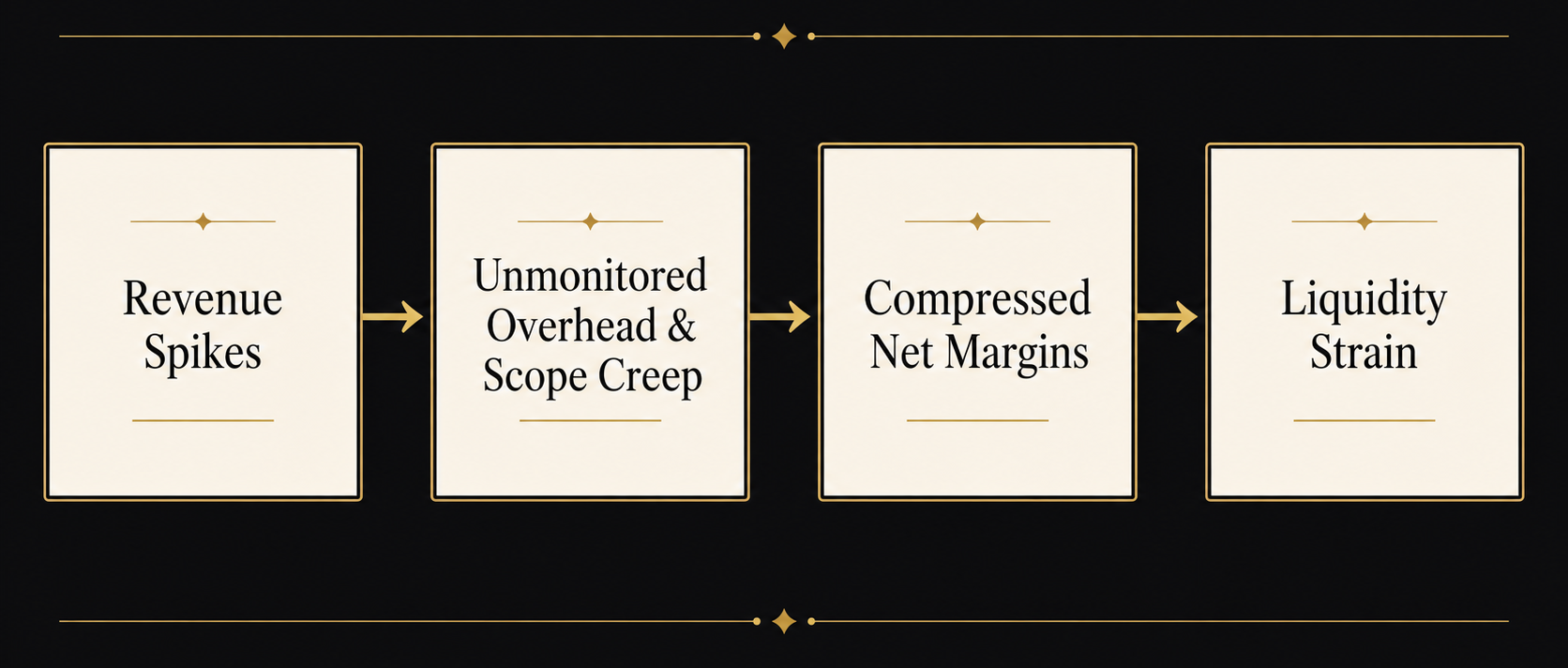
One of the most dangerous assumptions in business is that rising top-line revenue equals a healthier company. Revenue can surge while net margins compress due to labor capacity bottlenecks, unmonitored vendor price hikes, and scope creep.
Without structured accounting that breaks down margins by service line, client type, or department, low-margin growth hides inside total revenue. The company works harder and manages higher volume, but generates less spendable cash.
2. The Reporting Delay Problem
When financial reports take weeks to close, leadership makes current operational commitments using historical data. Approving new hires, committing to multi-year leases, or taking owner distributions without real-time financial visibility transforms strategic planning into guesswork. Monthly reporting must function as operational intelligence, not a historical cleanup exercise.
3. Forward Cash Visibility vs. Bank Balance Checks
Growth consumes cash long before it collects cash. Expanding payroll, purchasing inventory, and investing in equipment require liquid capital upfront.
Checking a static bank balance only reveals what exists today—it obscures upcoming payroll, vendor payables, and tax obligations. Sustainable growth requires a 13-week rolling cash-flow forecast that models timing gaps between receivables and payables.
4. Modernizing Internal Controls for 2026 Risks
In a small startup, informal owner oversight is sufficient. In a scaling firm, dozens of transactions move through the business daily. Informal trust is not a control system.
In today's digital landscape, internal controls must extend beyond basic expense approval tiers. They require advanced safeguards, including dual-authorization protocols for ACH/wire transfers and automated vendor verification to protect corporate accounts against AI-driven invoice fraud and Business Email Compromise (BEC).
Dismantling the "Coordination Trap"
As an enterprise scales, financial data fragments across isolated silos: bookkeepers record past entries, payroll providers process wages, CPAs handle annual filings, and operations tracks delivery.
This creates The Coordination Trap, where the owner is forced to act as an exhausted translator between disconnected systems.

Financial structure replaces this fragmentation with an integrated operating system. Accounting closes the ledger, operations delivers capacity insights, payroll manages compensation mechanics, and proactive tax strategy aligns with the One Big Beautiful Bill Act (OBBBA) to protect cash flow.
Growth Should Not Outrun Control
Scaling an enterprise without financial infrastructure creates decision fatigue, tax anxiety, and cash instability. Financial structure removes the drama from scaling. It converts raw activity into actionable intelligence, ensuring leadership retains total visibility, stability, and control as the business expands. Let Olga Kvach CPA build the structural architecture your growth deserves.
📅 Ready to Scale Your Enterprise Without Losing Control?
Don't let operational friction, unmanaged risk, or cash instability undermine your growth momentum. Partner with Olga Kvach CPA to construct the financial architecture, internal controls, and rolling forecasts your scaling business requires.

Comments