.png)
Why Financial Visibility Matters Before Making Major Investments
Introduction: The Investment Decision Beneath the Purchase
Major investments usually arrive with an exciting narrative attached:
A second location expands market share.
A specialized equipment upgrade doubles manufacturing capacity.
An enterprise software migration eliminates operational friction.
An acquisition adds immediate client volume, talent, and regional reach.
On the surface, the decision looks like progress. The opportunity is compelling, and leadership can easily imagine what the company will look like after the capital is deployed.
However, the purchase price is rarely the full financial commitment. A major investment doesn't just affect the asset being acquired—it directly alters cash flow, debt capacity, tax exposure, working capital, liquidity reserves, and operational flexibility.
At Olga Kvach CPA, we rarely view major investments as isolated purchases. We view them as strategic financial decisions that must be modeled before capital is committed.
The core question is never simply, "Can we afford the purchase price?" The real question is: "Can the enterprise absorb the full financial impact of this decision under more than one possible economic outcome?"

The Purchase Price Is Not the Total Commitment
One of the most common mistakes growing businesses make is evaluating a major CapEx or expansion project based strictly on the quoted invoice or sale price.

A major investment requires a secondary wave of hidden capital outlays that emerge after the deal is emotionally approved:
Investment Type | Quoted Cost | Hidden Capital Requirements |
Equipment / Machinery | Sticker / Invoice Price | Rigging, electrical upgrades, operator training, temporary downtime, warranty contracts. |
Facility / New Location | Lease / Buildout Estimate | Security deposits, utility drops, local licensing, initial inventory, ramping payroll. |
Software / Tech Stack | License Fee | Migration consultants, API integration, team productivity loss during onboarding. |
Business Acquisition | Purchase Price | Legal/accounting fees, integration costs, client retention buffer, working capital reserves. |
Evaluating an opportunity without modeling these surrounding costs creates immediate cash compression. Leadership must distinguish between what an investment costs and what an investment requires.
Profitability Is Not Liquidity: The Cash-Timing Gap
An investment can be highly profitable on a multi-year accrual basis while creating severe short-term cash distress.
Your profit and loss statement may eventually reflect strong net returns, improved gross margins, and operational leverage. But cash flow operates on a completely different timeline. The business must pay upfront vendor deposits, legal fees, site prep, and payroll long before the asset generates its first dollar of collections.
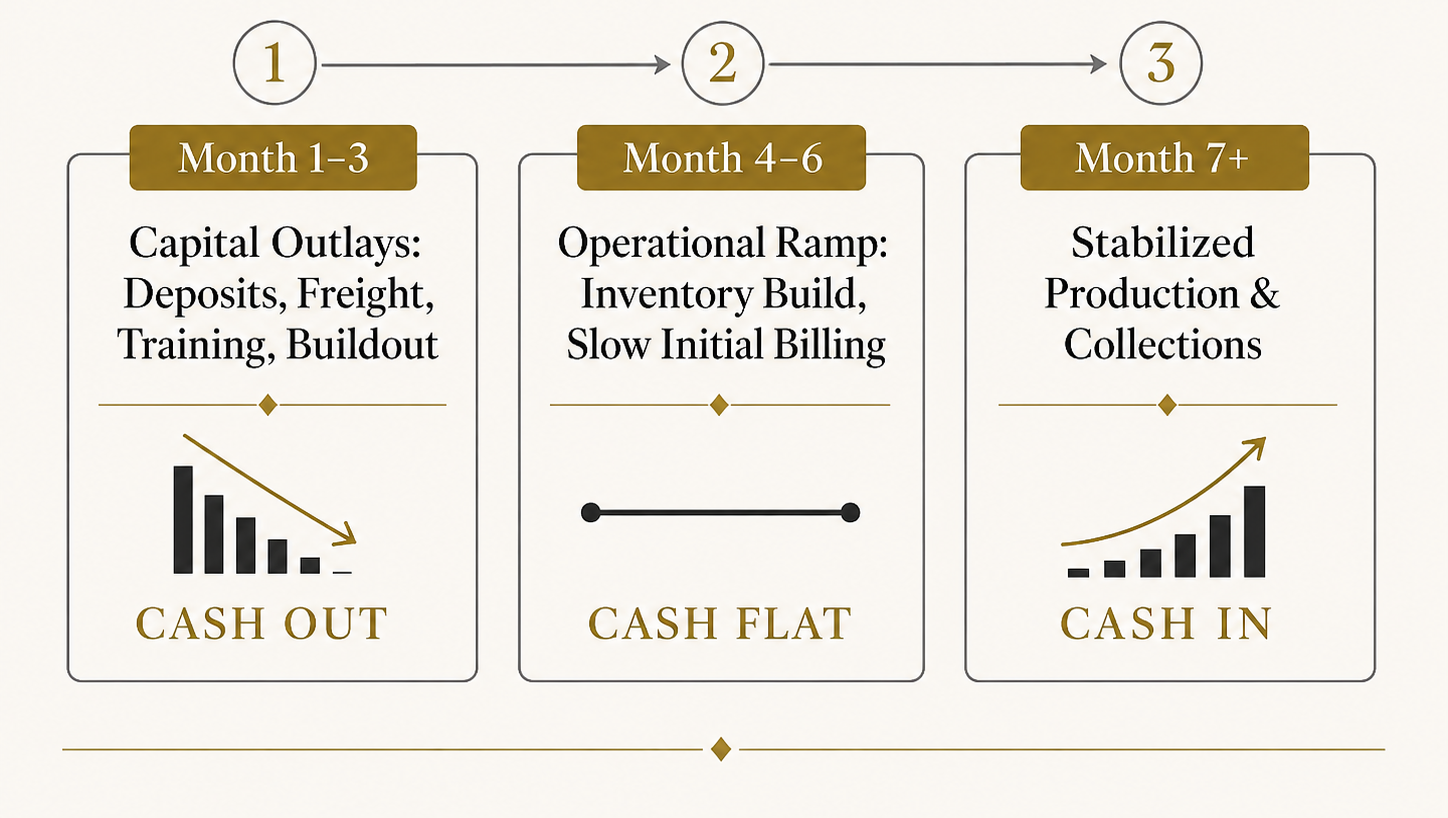
A business rarely faces crisis because an investment was fundamentally unprofitable on paper. It faces crisis when cash is unavailable on the exact date payroll, tax obligations, debt service, or vendor invoices fall due. Before committing capital, leadership needs a forward-looking cash flow forecast that isolates how low liquid reserves will drop during the ramp-up phase.
The Three-Scenario Stress Test
Every major investment should be stress-tested across three distinct economic realities before signing a contract:
The Upside Case: The asset performs efficiently, ramp-up meets targets, and revenue accelerates on schedule.
The Likely Case: The realistic baseline based on historical operational performance and current market data.
The Downside Case: Implementation takes 60 days longer, costs exceed budget by 20%, and initial collections lag.
The downside case is the most critical model. Growth decisions must be survivable. If the downside model pushes your cash balance below the company’s mandatory operating reserve, the investment shouldn't necessarily be canceled—it needs to be restructured.
Restructuring might mean phasing the rollout, negotiating milestone-based vendor payments, securing an expanded working capital line beforehand, or altering the debt-to-equity financing mix.
Debt Covenants and 2026 Tax Strategy
Debt Capacity & Covenant Risk
Financing an investment preserves cash, but it introduces fixed obligations. Lenders frequently impose strict covenants—such as maintaining a minimum Debt Service Coverage Ratio (DSCR) or a ceiling on total leverage. If a new investment's revenue ramp is delayed, falling margins can trigger a covenant breach, restricting owner distributions or accelerating debt paybacks.
Aligning the Investment with 2026 Tax Rules
Tax strategy should support an investment decision, not justify a bad one. Under the permanent provisions of the One Big Beautiful Bill Act (OBBBA), capital decisions carry massive tax-planning leverage:
100% Bonus Depreciation: Qualified equipment, technology, and cost-segregated real estate improvements placed in service in 2026 qualify for immediate 100% Year-1 expensing.
Section 163(j) Interest Limitations: Debt-financed acquisitions must be evaluated against federal caps on business interest deductions to avoid unexpected tax surprises.
A tax deduction reduces taxable income, but it is not a direct cash reimbursement. Financial modeling ensures tax savings align with your actual cash timing.
Shifting from Optimism to an Investable Decision
A major investment transitions from a speculative idea into a sound strategic decision when leadership can clearly answer these core questions:
What is the total cash commitment including working capital and implementation lag?
How low does our liquid cash reserve drop in the downside scenario?
Does the debt structure match the asset's cash-generation timeline without threatening bank covenants?
How do 2026 bonus depreciation rules impact our quarterly estimated tax payments?
What specific operational metrics will trigger a course correction if the asset underperforms?
When your financial architecture can answer these questions with precision, you eliminate guesswork. You gain the clarity to deploy capital aggressively, protect your liquidity, and scale your enterprise with confidence. Let the team at Olga Kvach CPA build the strategic models your next major investment requires.
📅 Ready to Make Your Next Major Investment with Complete Financial Confidence?Don't let hidden costs or unexpected liquidity squeezes undermine your growth. Partner with Olga Kvach CPA to model your capital decisions, stress-test your cash flow, and build an investable financial strategy. 👉 Schedule Your Strategy Session Today



Comments