.png)
Why Strong Financial Oversight Creates Better Business Decisions
Introduction: Better Decisions Begin With Better Visibility
Most business decisions appear to happen in a single moment: a founder approves a new executive hire, leadership signs a commercial lease, a firm purchases capital equipment, or an owner takes a distribution.
The approval takes a few minutes, but the financial consequences remain inside the company for quarters or years. That is why strong decision-making depends on far more than instinct, experience, or raw confidence. It depends on visibility.
When leadership can clearly evaluate profitability, unit-level gross margins, tax exposures, debt obligations, and future liquidity constraints, decisions become deliberate. When that visibility is missing, even experienced founders operate from fragmented information.
At Olga Kvach CPA, we view financial oversight as the structural framework that closes
this visibility gap. It is not simply reviewing static monthly reports. It is a recurring operational rhythm that verifies ledger accuracy, interprets operational trends, models future scenarios, and gives leadership total control before pressure builds.

The Oversight Gap and Leadership Conversations
Many growing businesses maintain high levels of financial activity without true financial oversight. The bank accounts are reconciled, payroll runs on schedule, invoices go out, and tax returns are filed. Yet leadership still struggles to answer high-stakes strategic questions:
Why is liquid cash declining while top-line revenue is increasing?
Which specific service line or client tier is driving our actual net margin?
How much cash must be isolated today to fund upcoming quarterly tax obligations?
Which department expenses are growing faster than the revenue they generate?
This disconnect is The Oversight Gap. A company in this position has raw numbers, but lacks a structured process for converting those numbers into leadership intelligence.
Without oversight, leadership conversations revolve around surface symptoms: cash feels tight, the team feels overworked, or a department looks expensive. With oversight, conversations shift to root causes: cash is tight because receivables expanded from 30 to 48 days, payroll grew ahead of revenue, and tax reserves were never separated from operating funds.
Separating Signal from Noise: The KPI Matrix
Responding to financial uncertainty by generating endless spreadsheets and dashboards often creates confusion rather than clarity. True oversight relies on focused Key Performance Indicators (KPIs) tied directly to your underlying business model.
Business Model | High-Noise Metric (Vanity) | High-Signal KPI (Operational Driver) |
Service & Consulting | Total Top-Line Billed Revenue | Direct Labor Utilization & Contribution Margin by Service Line |
Product & E-Commerce | Gross Website Traffic & Orders | Inventory Velocity, Fulfillment Cost per Unit, & Cash Conversion Cycle |
Recurring / Retainer | Total Active Client Count | Net Revenue Retention, CAC Payback Period, & Churn Velocity |
The Core Elements of Strategic Oversight
1. Governance Without Bureaucracy
Governance is not corporate red tape; it is protection. As a company scales, informal oversight becomes a liability. A mature financial architecture defines clear approval tiers, clean payment authorization pathways, and strict access controls.
In today's operational environment, this includes modern digital safeguards—such as multi-factor dual-authorization for wire transfers and automated vendor verification to protect corporate treasury against AI-driven invoice fraud.
2. Forward-Looking Cash Oversight
Reviewing a static bank balance every morning is not cash oversight; it is cash observation. A bank balance shows what exists today, not what is already committed to upcoming payroll, vendor payables, tax deposits, and debt service.
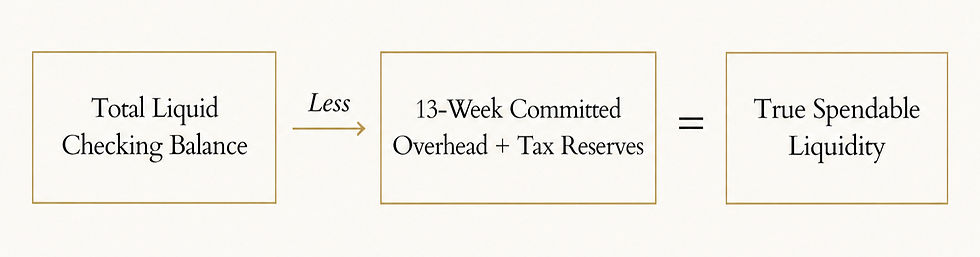
True cash oversight replaces daily bank balance checks with a 13-week rolling cash-flow forecast. This tool separates total cash balance from true spendable liquidity, allowing leadership to identify potential shortfalls months in advance while options remain cheap and flexible.
3. The Downside Stress Test
Most business forecasts act as targets: they assume sales goals are hit, hiring stays on schedule, and clients pay on time. Strategic oversight mandates testing your operations against a Downside Scenario:
If revenue comes in 15% below plan, how many weeks of runway remain?
If a key enterprise client delays payment by 60 days, can payroll and tax reserves remain fully funded?
If a new service line takes two quarters longer to stabilize, does the enterprise possess sufficient capital reserves?
A downside model does not prevent a business from taking risks. It ensures the risks the enterprise accepts are entirely survivable.
Eliminating the "Coordination Trap"
Financial oversight frequently breaks down when operations, sales, payroll, and tax strategy operate in separate silos. Sales forecasts contracts that operations lacks capacity to deliver, payroll processes unmodeled bonuses, and tax planning relies on outdated ledgers.
This creates The Coordination Trap, where the owner is forced to act as an exhausted human translator between disconnected systems.

A structured oversight system unifies these functions into a single operating rhythm:
Accounting closes historical records with accuracy.
Operations details capacity constraints and delivery drivers.
Tax Advisory models real-time liabilities and reserve requirements.
Leadership executes proactive capital decisions based on a single source of truth.
Conclusion: Building Your Decision Architecture
Strong financial oversight is not measured by the volume of reports a firm generates, but by the quality and speed of the decisions those reports enable.
When you eliminate the emotional fog of financial uncertainty, decision fatigue evaporates. You gain the confidence to hire aggressively, price accurately, manage debt responsibly, and protect your cash reserves.
Stop managing your business through the rearview mirror. Let the team at Olga Kvach CPA construct the structural financial architecture that gives you absolute clarity, control, and strategic direction.
Ready to Transform Your Financial Data into Clear, Confident Decisions?
Don't let fragmented numbers and financial uncertainty dictate the future of your enterprise. Partner with Olga Kvach CPA to build the financial architecture, KPI tracking, and forward-looking visibility your leadership team needs to scale with control.

Comments