.png)
Real Estate Investors Create Financial Clarity Through Better Reporting
Introduction: When Portfolio Growth Creates Financial Fog
Real estate investing often begins with a simple story: one property, one mortgage, one rent roll, and a handful of operating expenses that feel manageable enough to track on a basic spreadsheet.
Then, the portfolio grows. More properties are acquired, more distinct legal entities are created, and a wave of tenants, lenders, contractors, insurance policies, and depreciation schedules stack on top of one another. What once felt intuitive starts becoming difficult to interpret.
The investor may still be building wealth on paper, but their true financial clarity begins to shrink. This is one of the most common operational bottlenecks real estate investors encounter as they scale. The issue is rarely the properties themselves; it is that the reporting structure underneath the portfolio was never engineered to support the complexity the investor created.
At Olga Kvach CPA, we do not view real estate reporting as back-office bookkeeping. We view it as investment infrastructure. Once an investor loses visibility, every critical macro decision—whether to refinance, sell, hold, renovate, or acquire—degrades into guesswork.

The Portfolio Visibility Problem
Many investors mistakenly assume that if the rent is being collected and the mortgages are being paid, the portfolio is fundamentally healthy. This assumption is a dangerous illusion. A real estate portfolio can appear completely stable on the surface while quietly suffering from compressed margins, rising maintenance costs, inefficient debt, or un-forecasted tax exposure.
When your financial reporting is too general, these structural flaws disappear inside blended numbers. One highly profitable property accidentally hides an underperforming asset. One entity’s robust cash position masks another entity’s severe liquidity crisis. Without structured reporting, large capital improvements are miscategorized as standard repairs, and depreciation schedules become entirely disconnected from the actual asset history.
Growth naturally creates layers, and those layers must be separated to be understood. You don’t just need to know if your portfolio is profitable; you need to know exactly where your cash is being trapped, where your deductions are being maximized, and where risk is quietly accumulating.
Property-Level Reporting Is the Foundation
The first major shift from basic bookkeeping to true real estate reporting is the implementation of asset-by-asset visibility. A scaling real estate investor cannot afford to rely on a single, blended profit and loss statement that rolls every location into one indistinct financial picture. Each property must maintain its own clear financial identity.
Without this granular architecture, strategic decision-making operates in a fog. A property with strong nominal rent growth may look exceptional until property-level reporting reveals that localized utility spikes, insurance premiums, and maintenance outlays are systematically compressing its net return. Conversely, an asset that looks underwhelming from a pure cash flow perspective may actually be driving superior long-term wealth via forced appreciation or strategic tax positioning.

Property-level reporting transforms historical data into active investment intelligence, allowing you to measure the true return on equity for every asset in your portfolio.
Depreciation Architecture in the 2026 Landscape
Depreciation is one of the most powerful wealth-preservation features of real estate, but it is also the easiest area to mismanage when reporting systems are disorganized. Under standard IRS parameters, residential rental properties are depreciated over a 27.5-year recovery period, while nonresidential commercial properties use a 39-year schedule, both utilizing the mid-month MACRS convention.
However, scaling portfolios are never static. Investors constantly renovate, replace roofs, upgrade HVAC systems, and improve interiors. Each of these components carries completely different tax treatments based on asset classification, cash outlays, and exact placed-in-service dates.
The 100% Bonus Depreciation Engine
Under the permanent provisions of the One Big Beautiful Bill Act (OBBBA), 100% bonus depreciation is a major driver of real estate tax strategy. By deploying a Cost Segregation Study, investors can strip out short-life personal property (such as specialty fixtures, appliances, and flooring) and 15-year land improvements (such as decks, fences, and sidewalks) to write off 100% of those costs entirely in Year 1.
The opportunity here isn't just the tax code itself—it is having financial records clean and contemporaneous enough to survive IRS audit scrutiny when you execute these accelerated strategies.
Repairs vs. Improvements: The $2,500 Safety Valve
Misclassifying property expenses is one of the most frequent triggers for real estate tax audits. The dividing line between a current-year repair and a capitalized improvement requires strict data entry discipline:
Repairs: Expenses that merely maintain a property in its standard operating condition (e.g., patching a roof leak, fixing a broken pipe, or painting a room). These are fully deductible in the current tax year.
Improvements: Structural alterations that add material value, prolong an asset's life cycle, or adapt it to a new use (e.g., a total kitchen remodel, a new central HVAC system, or structural additions). These must be capitalized and depreciated over time.
The De Minimis Safe Harbor Shortcut
To reduce administrative friction, our financial architecture utilizes the IRS De Minimis Safe Harbor election. This gives investors the legal right to immediately expense any single invoice or individual asset purchase up to $2,500 in the year of purchase—even if it technically qualifies as a permanent improvement, such as a brand-new water heater or appliance.

Entity Reporting and the Coordination Trap
As portfolios expand, asset protection demands a multi-entity structure. You might have separate LLCs holding individual buildings, a centralized property management company handling operational fees, and a master holding company positioned above the entire enterprise.
While this design is excellent for isolating liability, it frequently triggers the Coordination Trap if your accounting infrastructure isn't integrated.
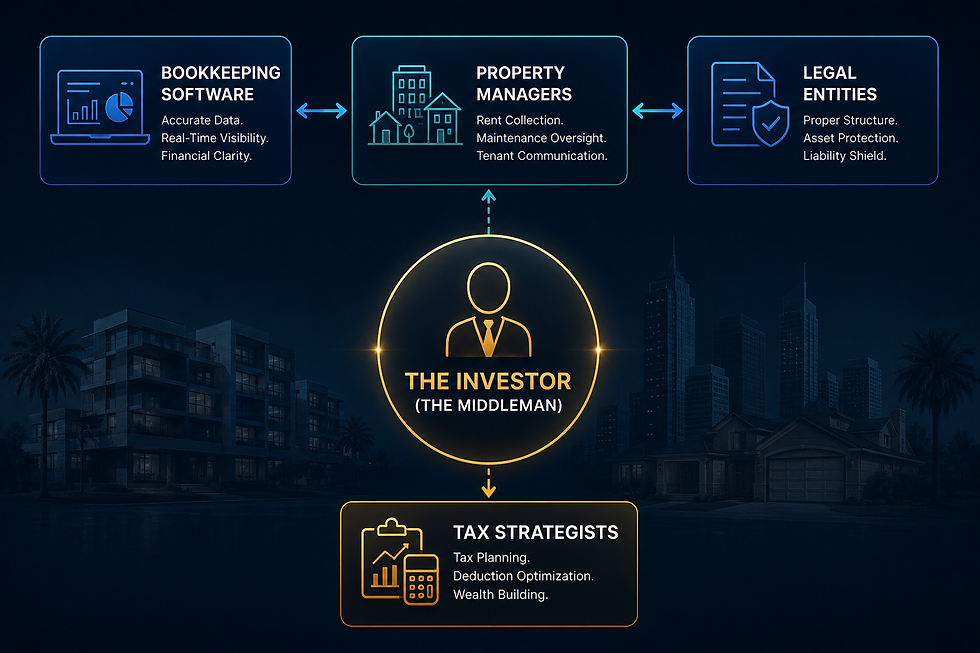
Without a centralized reporting authority, the investor becomes an involuntary middleman, spending endless energy translating numbers between property managers, lenders, and tax preparers. Entity-level reporting ensures your properties don't just function as isolated silos, but interact efficiently inside your broader estate and wealth preservation plan.
Real Cash Flow Modeling Beyond the Rent Roll
A rent roll is an operational tool, not a cash flow model. A rent roll tells you what gross revenue should be collected; it completely fails to reveal what your portfolio is truly producing after accounting for economic vacancies, localized tax adjustments, debt amortizations, and capital expenditure reserves.
True real estate cash flow reporting integrates forward-looking timelines. An asset may look highly profitable this month while carrying a mandatory roof replacement next quarter, an adjustable-rate refinancing trigger next year, or an aggressive quarterly tax estimate next month. By building forward-looking cash flow visibility into your accounting system, you purchase the most valuable asset available to an investor: time. Time to adjust rents, time to reserve capital, and time to refinance structurally before a crunch occurs.
Conclusion: Shifting from Asset Accumulation to Portfolio Control
Real estate investing involves inherent market risks; financial confusion shouldn't be one of them. The scaling milestone requires moving away from casual transaction tracking and stepping into deliberate portfolio architecture.
When your bookkeeping is property-specific, your depreciation schedules are automated, your entity structures are integrated, and your tax forecasting is running continuously under 2026 guidelines, the financial fog completely lifts. Stop guessing at your true net returns. Let the team at Olga Kvach CPA build the structural financial architecture that allows you to scale your real estate legacy with absolute confidence.


Comments